Final Declaration (Year End)
What this is
Final Declaration is the annual confirmation you make to HMRC that all your income has been reported for the tax year. Under Making Tax Digital, it replaces the traditional Self Assessment tax return. After completing your four quarterly updates throughout the year, Final Declaration is the last step where you review everything, make any year-end adjustments, and confirm to HMRC that your records are correct and complete.
What you see on screen
The Year-End page at /app/year-end shows:
- An overview of the year-end process - the six stages HMRC requires before you can make your Final Declaration
- The six stages explained:
- Annual Allowances and Adjustments - capital allowances and non-allowable expenses for each business
- Accounting Method Confirmation - confirming cash basis or accruals for each income source
- Business Source Adjustable Summaries - reviewing cumulative totals and submitting accounting adjustments
- Losses and Reliefs - declaring brought-forward losses and making loss claims
- Other Income Sources - submitting dividends, savings, employment income, and other taxable income
- Final Declaration - reviewing the tax calculation, confirming correctness, and making the legally-binding declaration
- Status indicators for each stage showing whether it is available, in progress, or planned for future release
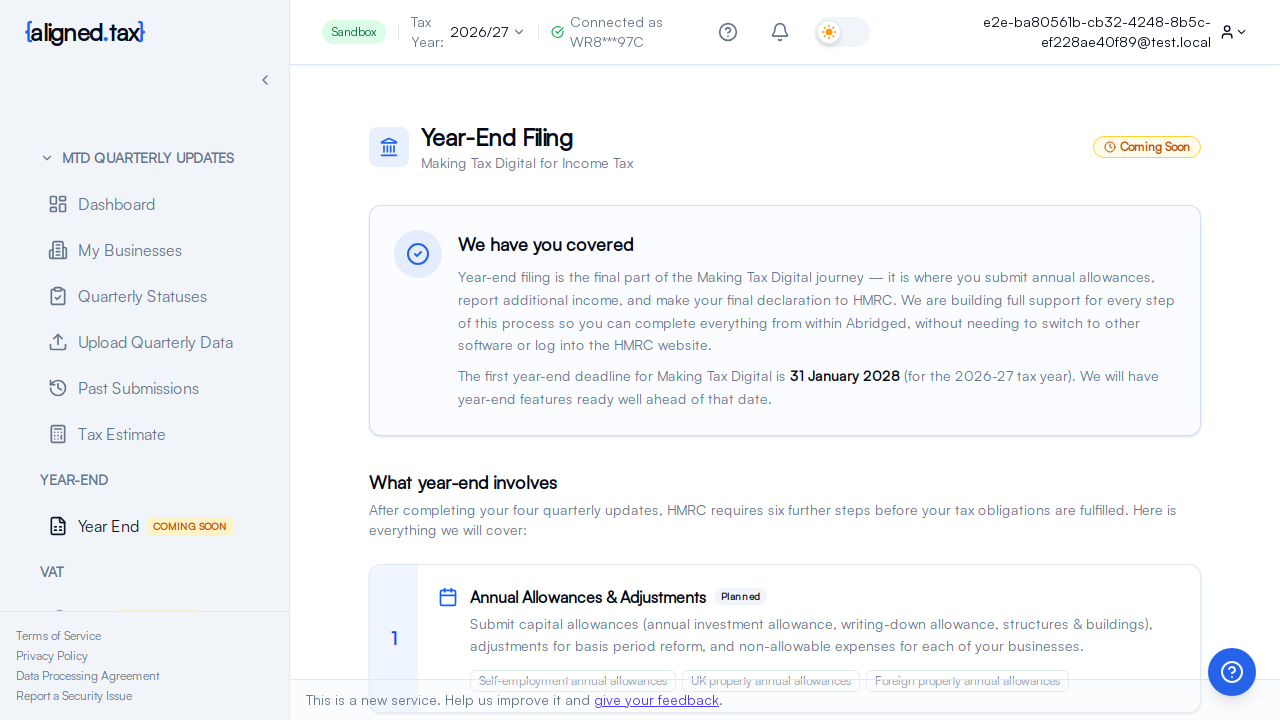
How Final Declaration works
Before you can declare
To make your Final Declaration, you must first:
- Complete all four quarterly updates for the tax year - all quarterly obligations must show as “Fulfilled”
- Submit annual allowances and adjustments for each income source
- Confirm your accounting method for each business
- Review your Business Source Adjustable Summaries and submit any corrections
- Declare any losses and make loss claims if applicable
- Report other income that is not covered by quarterly updates (dividends, savings, employment income)
Making the declaration
Once all prerequisite steps are complete:
- HMRC calculates your final tax liability based on everything submitted
- You review the calculation in full - income, allowances, deductions, and tax due
- You confirm that the information is correct and complete
- You submit the Final Declaration - this is a legally-binding confirmation
Things to know
- The deadline is 31 January following the tax year. For the 2025-26 tax year, Final Declaration must be made by 31 January 2027.
- Final Declaration replaces the old Self Assessment return. Under MTD, you no longer file a traditional tax return. Instead, your quarterly updates plus Final Declaration serve the same purpose.
- It is legally binding. When you make your Final Declaration, you are confirming to HMRC that the information is correct and complete to the best of your knowledge. This carries the same legal weight as signing a tax return.
- You can amend after declaring. If you discover an error after making your Final Declaration, you can submit an amendment within the allowed window (typically 12 months).
- Some year-end stages are coming soon. Aligned is rolling out the full year-end workflow in stages. The Year-End page shows which stages are currently available and which are planned.
If something goes wrong
Missing quarterly updates blocking declaration
All four quarterly obligations must be fulfilled before you can make your Final Declaration. Check your Quarterly Statuses page to see which quarters are still open, and submit data for them first.
Calculation does not match your expectations
If the tax calculation looks wrong, review each component:
- Are all quarterly updates submitted correctly?
- Have you claimed all applicable allowances?
- Is any income missing or duplicated? You can resubmit quarterly data or adjust allowances before making the final declaration.
“Not yet available” for a stage
Some year-end stages are being released progressively. The Year-End page shows the current status of each stage. Where a stage is not yet available in Aligned, you may need to use HMRC’s own online services as a fallback.
FAQ
When does the tax year end?
The UK tax year runs from 6 April to 5 April. For example, the 2025-26 tax year runs from 6 April 2025 to 5 April 2026.
Is Final Declaration the same as filing a tax return?
Under MTD, Final Declaration serves the same purpose as the old Self Assessment tax return. Instead of filing one annual return, you make four quarterly updates plus a Final Declaration.
What happens if I miss the 31 January deadline?
HMRC may charge penalties for late Final Declarations. The penalty system for MTD is being phased in - see The Penalty-Free Period for current details.
Can my accountant make the Final Declaration for me?
Yes. If you have authorised an agent to act on your behalf, they can submit the Final Declaration on your behalf through Aligned.