Next Making Tax Digital quarterly update deadline: 7 November 2026.Start filing now

How to fill it in

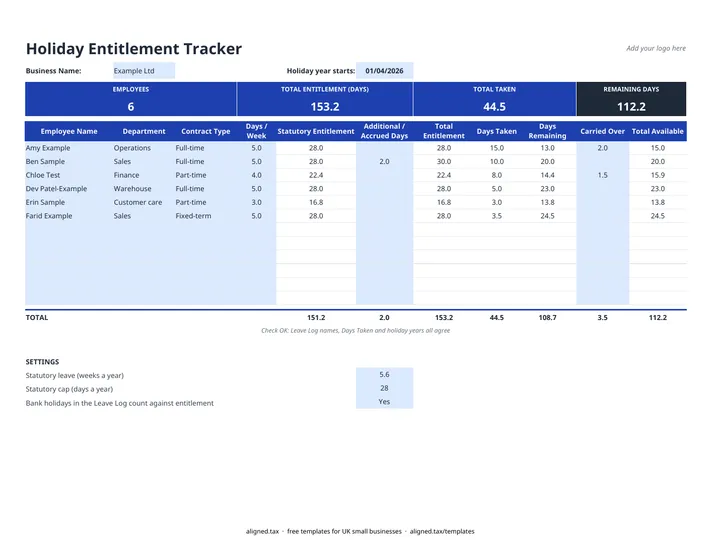
  1. On the Holiday Tracker sheet, enter your business name and the date your holiday year starts in Holiday year starts. Leave before that date is ignored.

  2. Add one row per employee: Employee Name, Department, Contract Type and Days / Week. Statutory Entitlement fills in as days a week x 5.6, capped at 28.

  3. Enter any extra contractual or accrued days in Additional / Accrued Days, and any days brought forward in Carried Over.

  4. Record each period of leave on the Leave Log sheet: Employee Name (spelt exactly as on the tracker), Leave Type, Start Date, End Date and Days Taken, the working days the person actually loses under their own pattern (half days such as 0.5 are fine). The grey Mon-Fri Estimate is a guide only. Split leave that crosses the holiday year end into two rows.

  5. Back on the Holiday Tracker, Days Taken adds up annual leave from the log, plus bank holidays if the setting under the table says Yes. Sick and unpaid leave are left out.

  6. Read Days Remaining and Total Available for each person, and check the line under the table, which flags any log entry whose name does not match an employee, that crosses the holiday year end, or that has no Days Taken.

This holiday entitlement calculator works out each employee’s statutory paid holiday for you: 5.6 weeks a year, calculated from the days they work each week and capped at 28 days. Add your team, log each booking on the Leave Log, and the tracker shows days taken, days remaining and total available for everyone in one Excel sheet.

How is statutory holiday entitlement worked out?

UK workers get 5.6 weeks of paid holiday a year. The tracker turns that into days by multiplying the days someone works each week by 5.6, then caps the result at 28 days, which is the statutory maximum.

Days worked a week Statutory entitlement
5 28 days
4 22.4 days
3 16.8 days
2 11.2 days
6 28 days (capped)

Anything you give on top, such as 25 days plus bank holidays, or long-service days, goes in Additional / Accrued Days, and Total Entitlement adds the two together. The 5.6 weeks and 28-day cap sit in labelled settings cells under the table.

How does the Leave Log feed the tracker?

Each row of the Leave Log is one period of leave, with a leave type of Annual leave, Bank holiday, Sick, Unpaid or Other. On each row you enter Days Taken: the working days the person actually loses under their own pattern. A Monday-to-Wednesday worker who takes a whole week off loses 3 days, not 5, and a half day is 0.5. A grey Mon-Fri Estimate sits beside it as a guide, but balances only ever use the Days Taken you enter.

Days Taken on the tracker adds up only the annual leave that falls inside the holiday year, plus bank holidays if you have told it to count them. Each row must sit inside one holiday year, so if someone books leave over the year end, enter it as two rows, one each side. A row that crosses the year end turns red and the check under the table counts it. Sick and unpaid leave are recorded but never reduce holiday. The log has 100 rows and dates are entered as dd/mm/yyyy.

What about irregular hours and leavers?

Since leave years starting on or after 1 April 2024, irregular-hours and part-year workers build up holiday at 12.07% of hours worked. The tracker records their accrued days rather than calculating them, so keep a note of hours worked alongside it. When someone leaves, Days Remaining is the figure to check against what they are owed for untaken leave, and holiday pay forms part of the payroll you report to HMRC.

If you run a small business and also file Self Assessment on your own profits, see how Making Tax Digital for sole traders changes your record keeping.
Holiday entitlement calculator and leave tracker: FAQs

Is this template free?

Yes. The holiday tracker is free to download; you just enter your email address to get the Excel file.

How many days holiday is a UK worker entitled to?

Almost all workers are entitled to 5.6 weeks of paid holiday a year. For someone working 5 days a week that is 28 days, and the statutory amount is capped at 28 days even for people who work 6 days. Employers can include bank holidays in that total.

How do I calculate holiday for a part-time worker?

Multiply the days they work each week by 5.6. Someone working 3 days a week gets 16.8 days, and someone working 4 days gets 22.4 days. The tracker does this for every employee once you enter Days / Week.

Does it work for irregular-hours or zero-hours workers?

Partly. Irregular-hours and part-year workers build up holiday at 12.07% of the hours they actually work, and the tracker has no hours-worked column. Leave their Days / Week blank and type the days they have accrued into Additional / Accrued Days.

Do bank holidays come out of the 28 days?

They can, if the contract says so. The tracker has a setting under the table: set it to Yes and bank holidays logged on the Leave Log count against entitlement, or No if you give bank holidays on top.

When it is time to file, use aligned.tax

Keeping your records in Excel? Read our guide to free MTD spreadsheet templates to see how aligned.tax sends your quarterly update to HMRC from an .xlsx file. Free for individuals, see pricing.

Using the Google Sheets copy? Download it as an Excel (.xlsx) file before uploading it to aligned.tax.