Next Making Tax Digital quarterly update deadline: 7 November 2026.Start filing now

How to fill it in

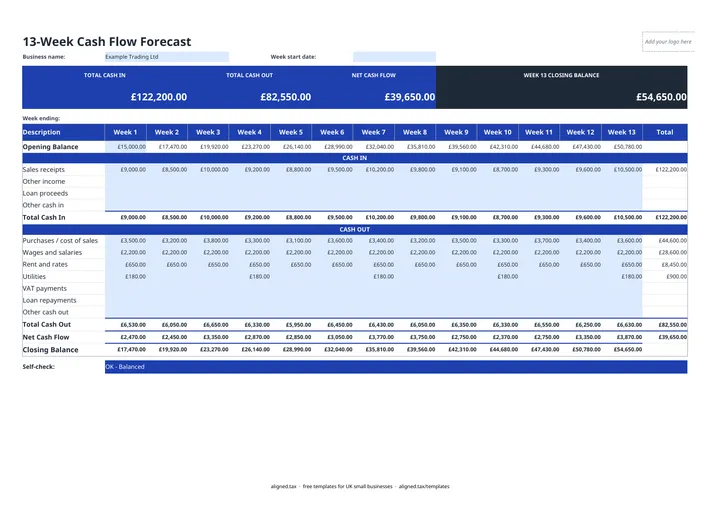
  1. On the 13-Week Cash Flow tab, enter your business name and the Week start date. The Week ending row fills in for all 13 weeks.

  2. Enter the Opening Balance: the money in the bank at the start of week 1.

  3. Under CASH IN, enter expected sales receipts, other income, loan proceeds and other cash in for each week.

  4. Under CASH OUT, enter expected purchases / cost of sales, wages and salaries, rent and rates, utilities, VAT payments, loan repayments and other cash out. Leave a cell blank if nothing is expected.

  5. Read Net Cash Flow and Closing Balance for each week. A negative balance shows in red brackets.

  6. Each week, roll the forecast forward: update the Week start date and Opening Balance and move the figures across. The Self-check confirms the week 13 closing balance adds up.

This free 13-week cash flow forecast template tracks a UK small business’s bank balance week by week for the next quarter. Enter a start date, opening balance and the cash you expect in and out each week. It fills in week-ending dates and shows net cash flow and the closing balance for every week, so you see when money gets tight.

What is a 13-week cash flow forecast?

It is a rolling, short-term forecast built on weeks rather than months. Monthly forecasts can hide a problem: a month may end in credit while the balance dips below zero in the middle, when wages go out before customers pay. Looking week by week shows those dips.

What the template includes

  • Week ending dates that fill in from the Week start date.
  • Cash in: sales receipts, other income, loan proceeds and other cash in.
  • Cash out: purchases / cost of sales, wages and salaries, rent and rates, utilities, VAT payments, loan repayments and other cash out.
  • Totals: net cash flow and closing balance per week, a Total column, and tiles for total cash in, total cash out, net cash flow and the week 13 closing balance.

Tips for an accurate short-term forecast

  • Enter cash when it hits or leaves the bank, not when you invoice or receive a bill.
  • Mark the weeks when large payments fall: payroll, quarterly rent, VAT and loan repayments.
  • Be cautious with receipts. If a customer usually pays late, forecast it late.
  • Compare each week’s forecast with what happened. Consistent gaps show where your assumptions need work.

For a longer view, use the 12-month cash flow forecast template.
13-Week Cash Flow Forecast Template (UK): FAQs

Is this 13-week cash flow template free?

Yes. It is free to download; you just enter your email address to get the Excel file.

Why 13 weeks?

Thirteen weeks is one quarter. It is short enough to forecast with real knowledge of upcoming bills and receipts, and long enough to spot a shortfall in time to act.

When should I use a 13-week forecast instead of a 12-month one?

Use the 13-week forecast when cash is tight, when large payments are close together, or when a bank or adviser asks for a short-term view. A 12-month forecast is better for planning the year as a whole.

How often should I update it?

Weekly. Replace the week just gone with what actually happened, update the opening balance, and add a new week at the end so you always look 13 weeks ahead.

When it is time to file, use aligned.tax

Keeping your records in Excel? Read our guide to Making Tax Digital for sole traders to see how aligned.tax sends your quarterly update to HMRC from an .xlsx file. Free for individuals, see pricing.

Using the Google Sheets copy? Download it as an Excel (.xlsx) file before uploading it to aligned.tax.